PLAYBOOK 02 · MEDICAL ENDOSCOPE COMPONENTS
How to Define Your Ideal Customer Profile for Component Sales
Why This Matters
“Companies that might buy” is not a definition. Without a clear ICP, every medical-looking company looks like a prospect, and you waste time on distributors, hospitals and non-medical optics that will never become a rod lens order.
Your ICP should tell the system — and your team — exactly what a qualified account looks like, so research and scoring have something concrete to measure against.
What to Enter: The Customer Profile Framework
Here is the customer profile framework a rod lens supplier enters — from the knowledge base that drives research, scoring and strategy.
Precision coating & assembly houses with in-house coating. Germany / Switzerland / Austria / USA. 5–150 staff. Need UNCOATED blanks. Highest value per deal.
Germany / Western Europe mid-to-small medical endoscope OEM brands that assemble complete endoscope systems under their own brands (Tuttlingen / Berlin cluster). They buy rod lenses to build complete scopes.
Eastern Europe + Latin America endoscope OEM brands (Poland, Czech, Hungary, Romania, Brazil, Mexico, Argentina). Own brand / assembly line, ISO 9001+.
India / Turkey / Russia endoscope OEM brands. Highest price sensitivity; leads require manual compliance review.
Veterinary endoscope assemblers — EU / US / AUS / NZ. No medical certification needed.
Industrial rigid borescope / inspection / NDT manufacturers — EU / US / JP / KR.
Endoscope repair centers + specialty integrators — EU / US / Middle East. Upgrade to A if they have their own assembly / coating capability.
<5 staff · virtual offices · pure traders · large OEM giants (Storz / Olympus / Stryker)
Why We Entered It This Way
A German coating/assembly house moved from a cold email to a first quote in about three months. The key: it was a Profile A target — it needed uncoated blanks and could validate the rod lens in-house, which made the sample the turning point.
See It in B2B Outbound OS
This is how the profile framework is stored and used downstream.
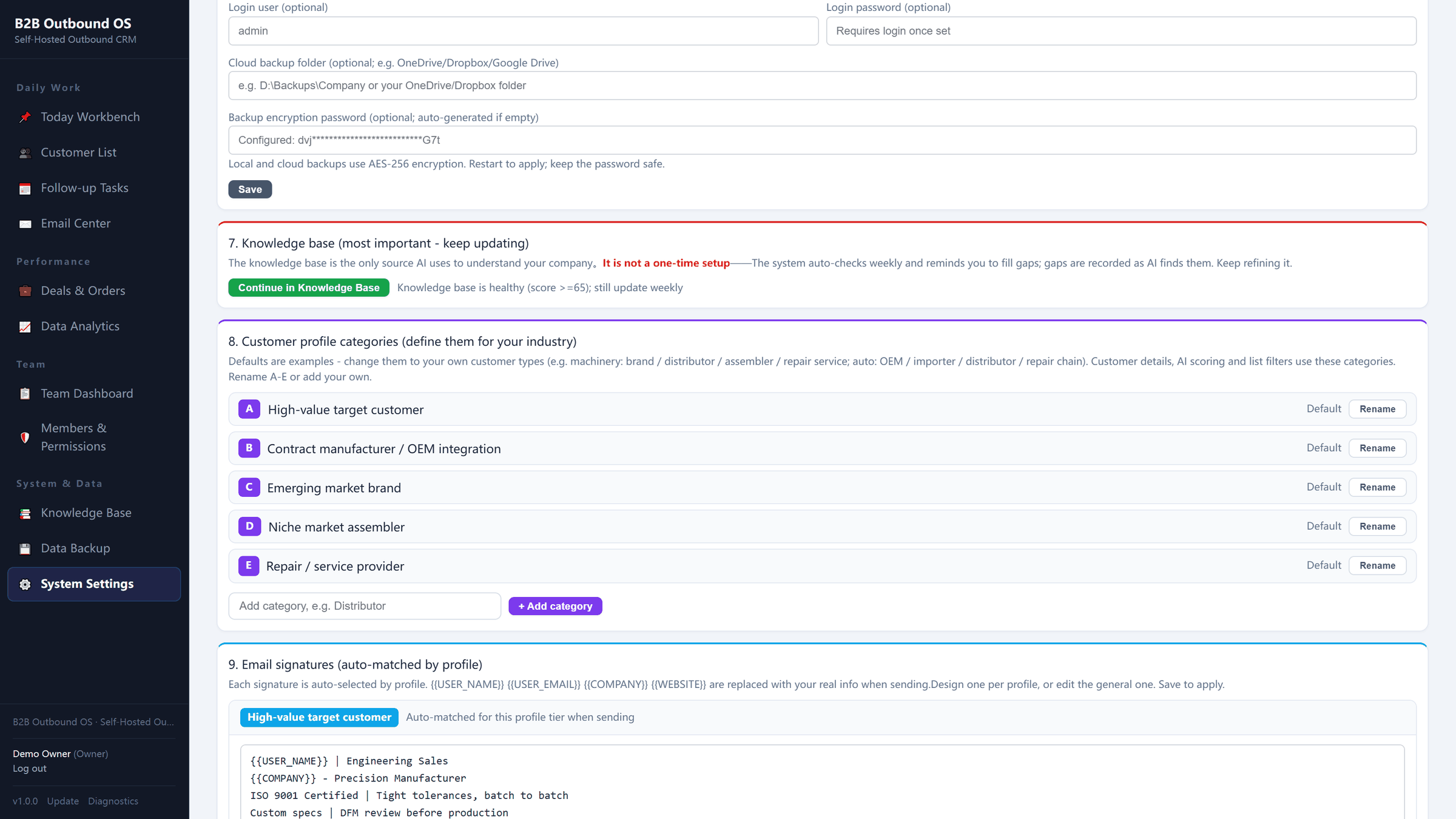
The ICP is not a checklist — it is the reference the system uses for research, scoring and strategy.
Do It Yourself
Now define yours. Replace our example with:
- Your primary profiles and resource allocation
- Your regional splits
- Your exclusions
- Your development priority